23 September 2026
Your Cash in Monero
Monero is built so digital cash stays private by default, with low fees, practical payments, and a network that does not depend on a central operator.
Overview
Monero has low fees, privacy by default, and a mining design meant to stay practical on ordinary CPUs. It is built for stores, customers, and ordinary transfers.
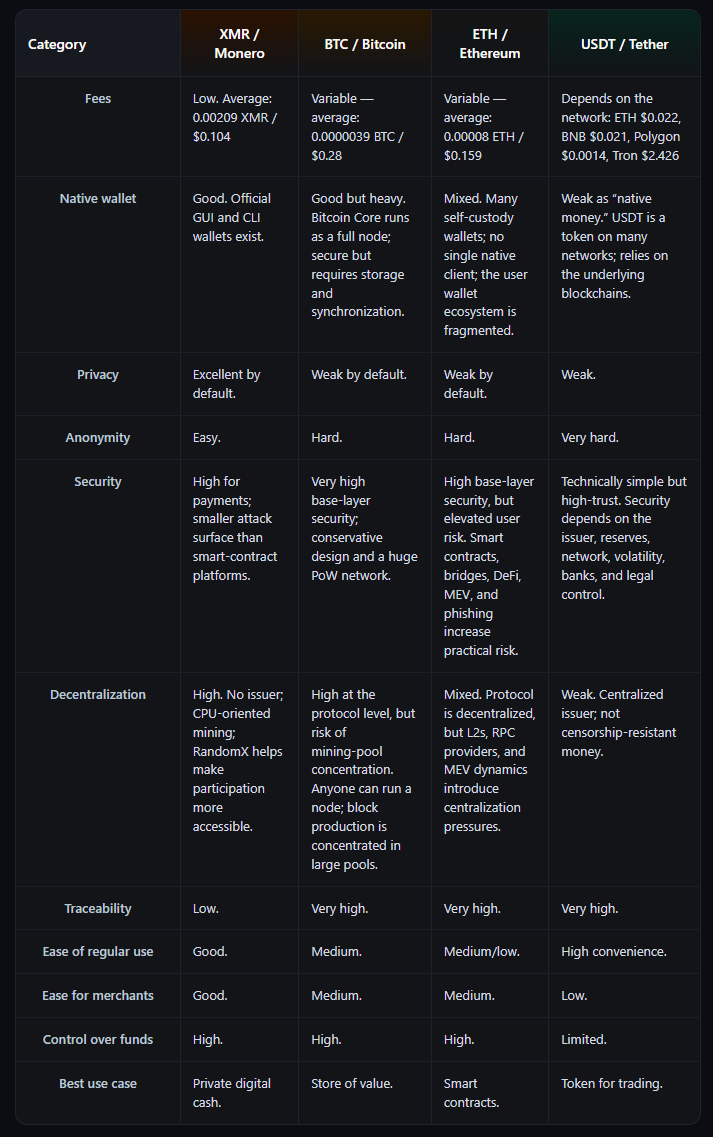
BTC, ETH, and USDT are what most people actually use. They are convenient. They are not private. An address does not contain a legal name, but once it is tied to a person, an exchange account, a shop, or an invoice, the history is public. That is a bad default for money.
Monero, commonly known by the ticker symbol XMR, is built around one specific idea: digital cash should behave like cash. It should be private by default, difficult to censor, and resistant to surveillance.
Problem: Transparent money is not private money.

In Bitcoin or Ethereum, a wallet address does not directly reveal a legal name. Once that address is linked to a person, an exchange account, a business, a donation page, a domain, or an invoice, the entire transaction history becomes readable.
This creates several problems:
- Anyone can view balances.
- Payments may reveal commercial connections.
- Past transactions can follow coins forever.
- Exchanges and analytical companies may blacklist contaminated funds.
- Users can be profiled by governments, companies, criminals, or competitors.
That is not how physical cash works. When you hand someone a banknote, the recipient does not automatically learn your full financial history. Later holders of that banknote do not inherit a permanent, visible record of every previous owner.
Monero is designed to restore that property of cash in digital form.
Solution: Privacy by default
Every Monero transaction hides three critical pieces of information:
- Who received the funds?
- Who sent the funds?
- How much was sent?
That is the goal, not a claim that nothing is visible. The fee, the number of inputs and outputs, the transaction size, and the time the transaction was mined are public. Recipient and amount are hidden from outside observers. Sender privacy is weaker: the network only learns that the real input is one of 16, not which one.
Monero makes this usable for everyday users. Anyone can use the native XMR wallet and manage their funds directly, without relying on an exchange or a custodial wallet. When cryptocurrency is stored on an exchange, it is not fully yours. The exchange decides when withdrawals are allowed, which transactions are blocked, and whether the account stays open. Third-party wallets can also introduce additional risk due to closed source code, remote infrastructure, or weak security.
How it's implemented:
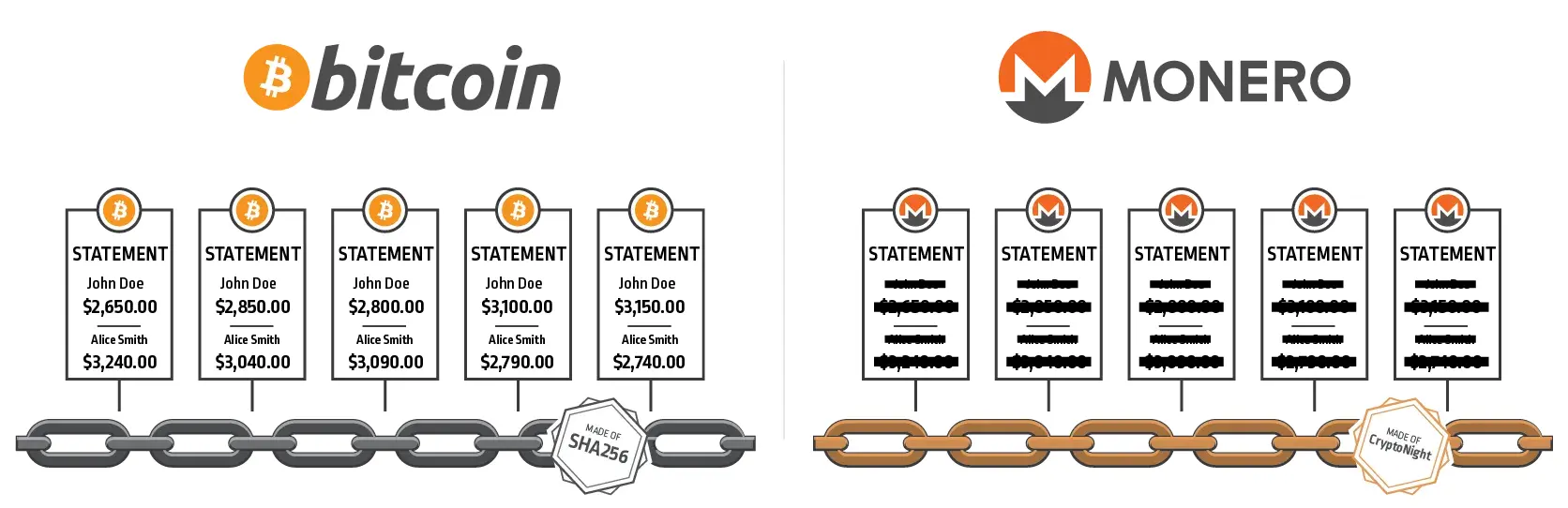
Monero combines several cryptographic techniques so transactions stay private while the network can still verify that no one is cheating.
Stealth Addresses: Hiding the Recipient
When someone sends XMR, the recipient's public address is not written on the blockchain. The sender derives a one-time output for that payment. The private view key can recognize it. The private spend key is required to spend it. An outside observer cannot link that output to the recipient's public address.
Ring Signatures: Hiding the Sender
To hide the sender, Monero uses ring signatures. A Monero transaction input is mixed with decoy inputs from the blockchain. The transaction proves that one of the possible inputs is real, without revealing which one.
Monero's ring size is 16: one real input and 15 decoys.
The signature proves the signer knows the secret for one member of that ring. It does not reveal which member. It also does not hide the sender among every output on the chain. The anonymity set is 16, and it is only as good as the decoys.
RingCT: Hiding the Amount
Privacy is incomplete if amounts stay visible. Even when addresses are hidden, precise amounts can still leak information. For example, a known invoice amount, salary amount, or exchange withdrawal amount can help link transactions.
Monero uses Ring Confidential Transactions, usually called RingCT, to hide amounts. The network can still verify that inputs and outputs are balanced correctly, but the public cannot see the exact amount transferred.
A Pedersen commitment is C = rG + vH. v is the hidden amount. r is a random blinding factor. G and H are public base points. C is what appears on chain.
Commitments can be added without opening them. The transaction proves that the hidden inputs equal the hidden outputs plus the fee. Range proofs (Bulletproofs+) prove each hidden amount is in a valid range, so a sender cannot hide a negative amount and inflate the supply. Observers learn the fee. They do not learn the amounts.
Decentralized Mining with RandomX
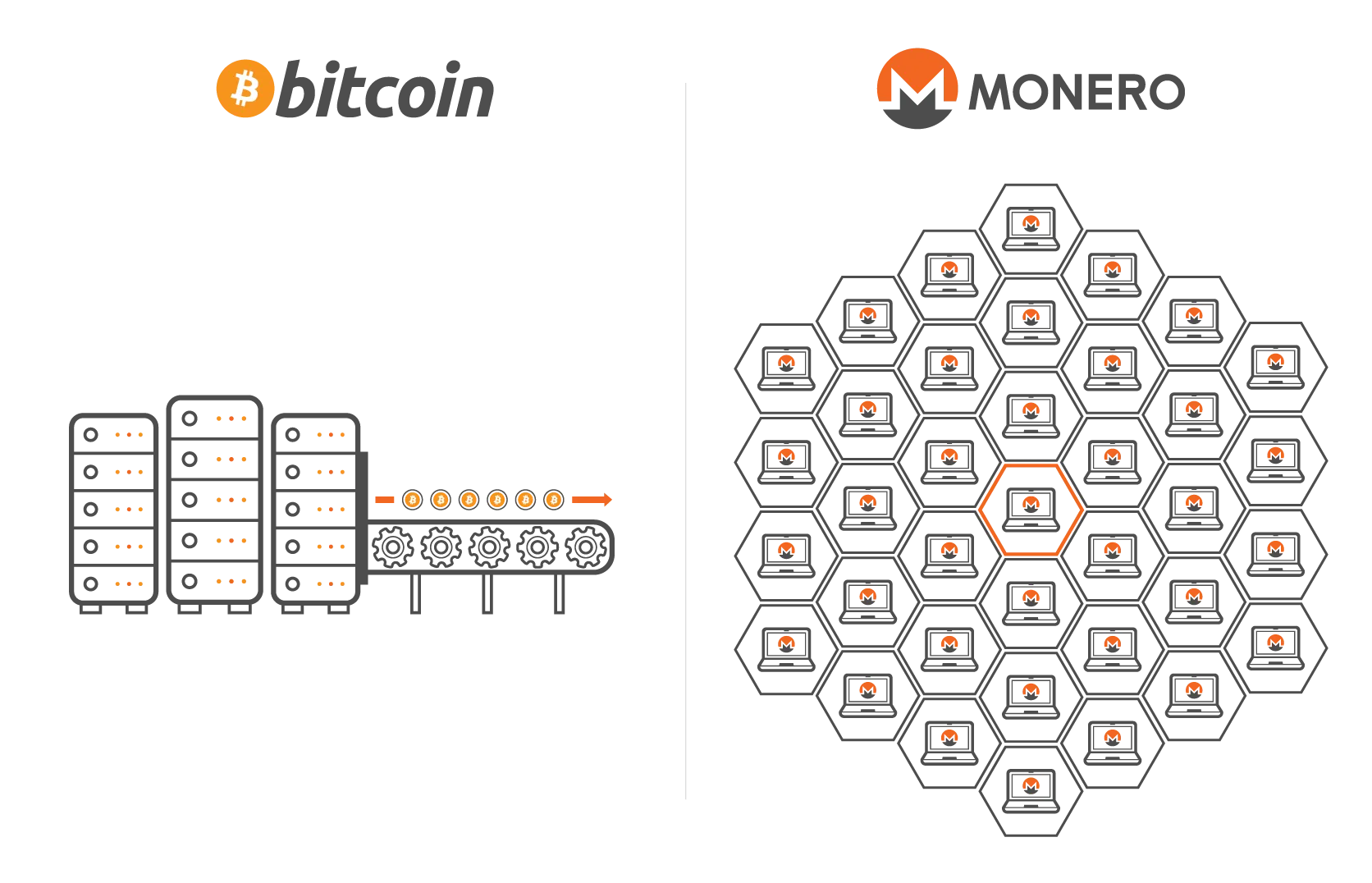
A censorship-resistant currency needs decentralized security. Many proof-of-work networks are dominated by specialized mining equipment. When mining requires expensive ASICs, power concentrates with large operators who have capital, cheap electricity, and industrial facilities.
Monero uses a proof-of-work algorithm called RandomX, designed to run efficiently on ordinary CPUs. The goal is not to make mining perfectly equal for everyone. Large miners can still exist. RandomX makes it harder for specialized hardware to dominate the network.
Tail Emission
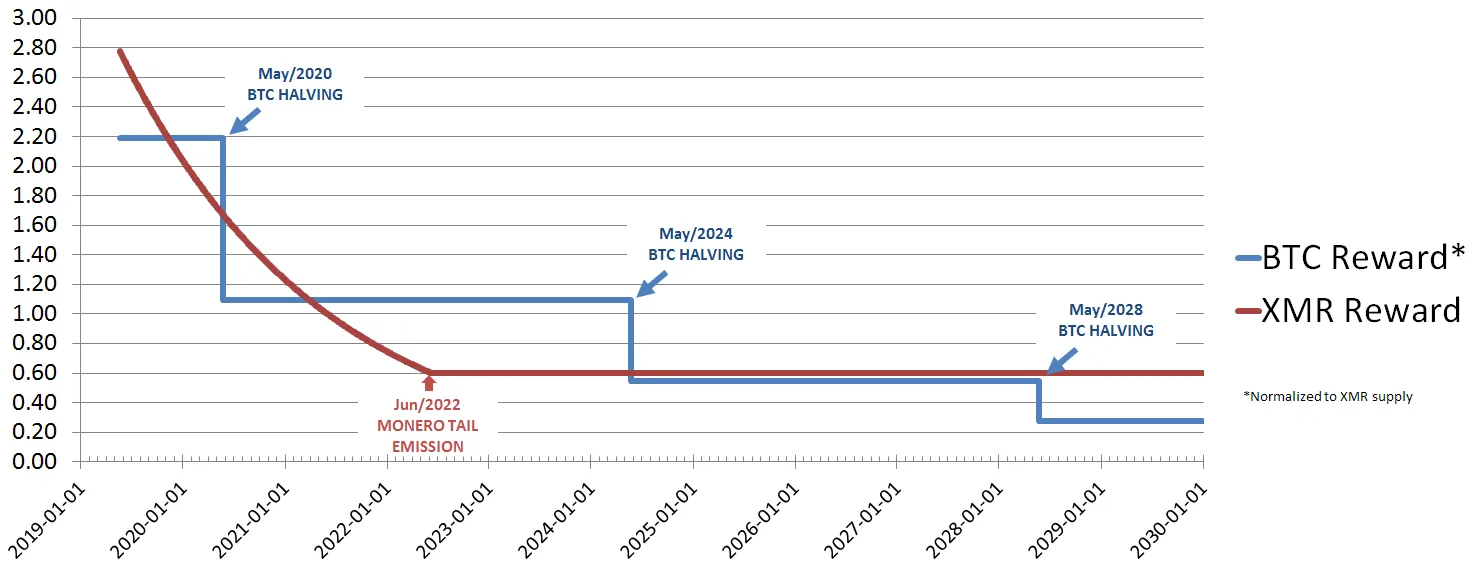
Bitcoin has a fixed supply limit of 21 million coins. Monero takes a different approach.
After the main emission phase, Monero keeps issuing a small, constant block reward called tail emission. That reward is currently 0.6 XMR per block.
It keeps paying miners, so the network does not have to rely only on transaction fees for long-term security. It also keeps fees more manageable. If miners are paid only by fees, those fees can spike when the network is busy or when the block reward is low.
The tail reward is 0.6 XMR per block, unless a miner publishes an oversized block and the block-weight penalty cuts it. That is a fixed amount of new coin, not a fixed inflation rate. Issuance stays flat while the supply grows, so the inflation rate falls. It is under 1% a year and keeps declining. Monero accepts that small, ongoing issuance in exchange for a mining reward that does not disappear.
Dynamic Blocks and Practical Payments
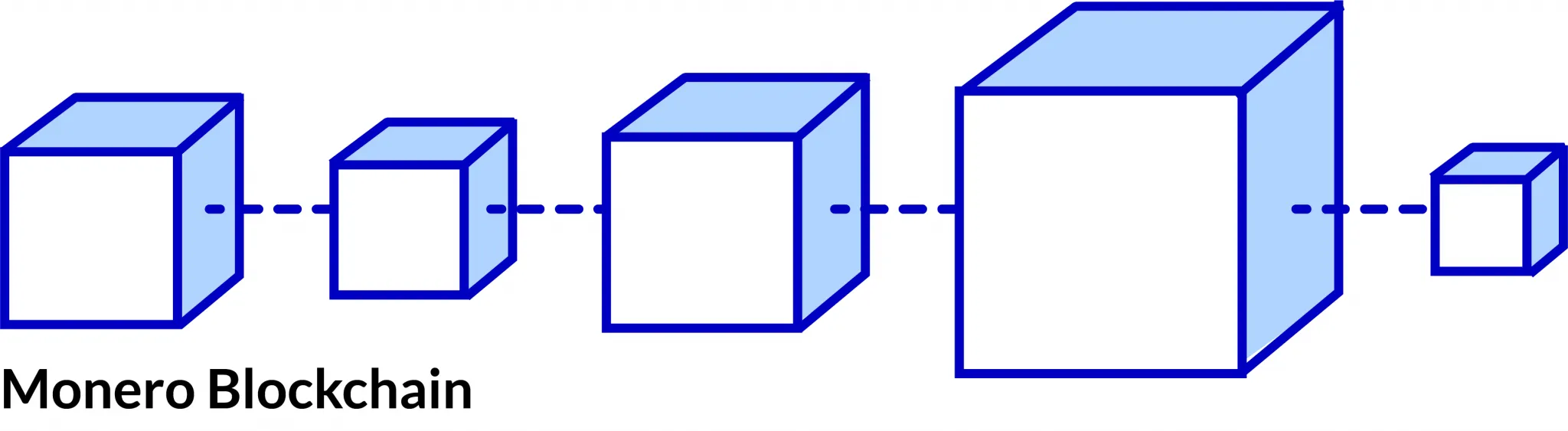
The currency has to be usable. If fees are too high, or confirmations become unpredictable, people stop using it for ordinary payments.
Monero uses a dynamic block size. Blocks can grow when demand rises, but penalty rules stop miners from expanding blocks for free. That gives Monero a more flexible fee market than a rigid block size.
Separating the Wallet and the Node
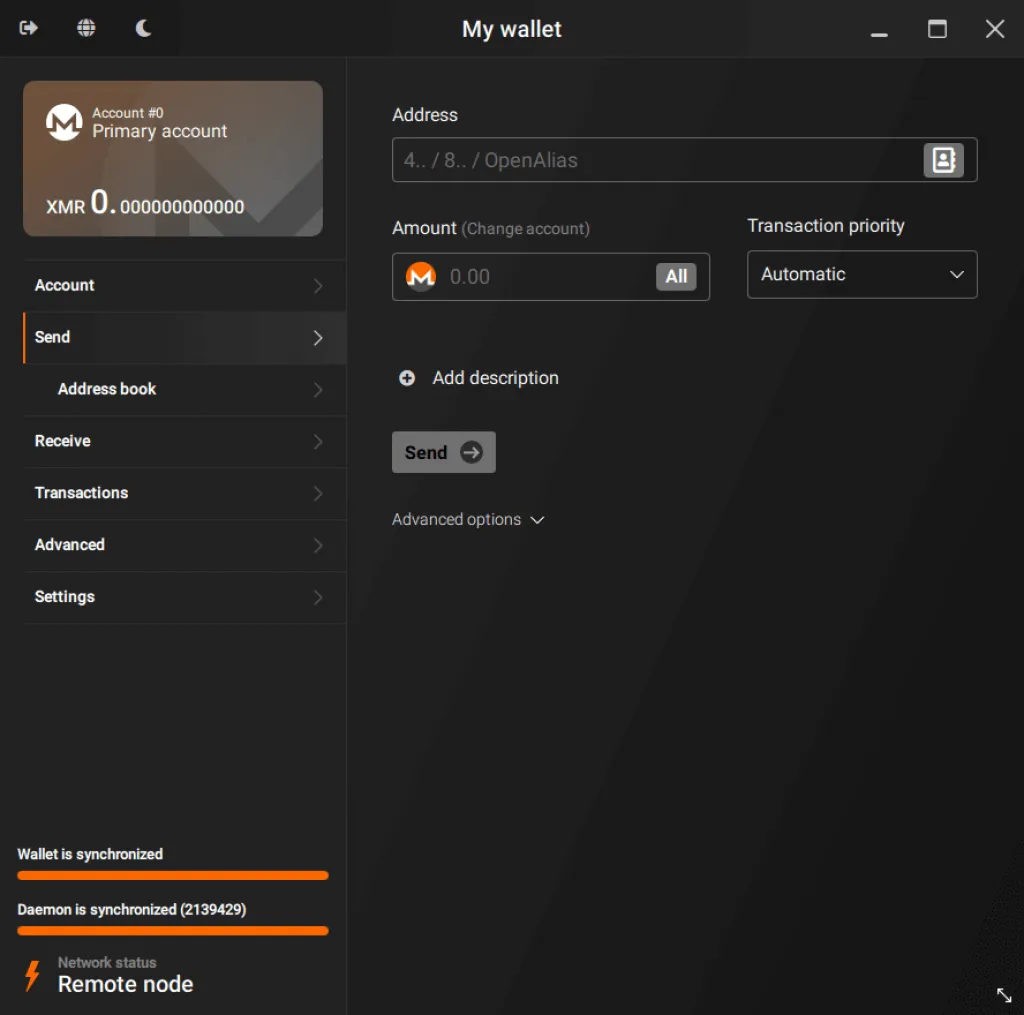
Monero separates the wallet from the node.
A node, called monerod, downloads and validates the blockchain. It connects to the Monero peer-to-peer network and relays transactions. The wallet stores the user's keys. It scans the blockchain, recognizes incoming payments, creates transactions, and signs them.
The node does not need the user's private keys. A user can run:
- A local node on the same computer
- A private node on a home server
- A node on a VPS
- A remote node controlled by someone else
The strongest privacy option is running your own node. Running it yourself stops a remote operator from seeing your wallet traffic. It does not hide your IP from your ISP or from peers. Dandelion++ helps with broadcast, and it is not a substitute for Tor or I2P. The strong setup is your own node over Tor or I2P. A remote node cannot steal funds, but it can leak metadata, including an IP address, wallet sync behavior, and transaction broadcast times.
Multisig in Monero
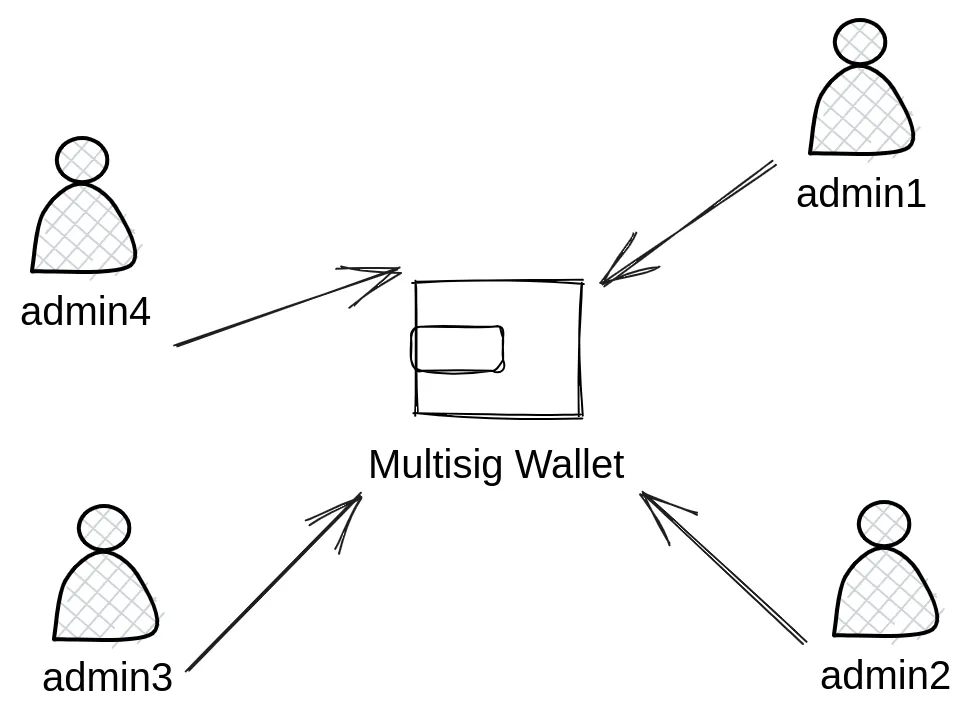
Multisig means several participants must approve a spend. Common setups are:
- 2-of-2
- 2-of-3
- 3-of-5
Unlike Bitcoin, Monero multisig is not exposed as a special public script on the blockchain. It is handled in the wallet through shared keys and cooperative signing.
That is useful for:
- Shared custody
- Escrow
- Estate planning
- High-security storage
- Business treasuries
Monero multisig is more complex than a normal wallet, and it is mainly used through command-line tools. It is powerful, and it is not a good starting point for beginners.
Misuse of Monero
For practical purposes, Monero is very hard to trace inside the Monero network itself. It cannot protect anything outside that network. It cannot hide real-world behavior, and it cannot protect you from social engineering attacks. What you do outside of it can easily de-anonymize your activities.
Always move funds through your own wallet.
You are only as private as the service that already knows you.
Never treat an exchange as a wallet. While the coins sit there, the exchange holds the keys and records the deposit, the withdrawal, the amount, and the time. A later observer still does not get a public graph of the Monero spends the way they would on Bitcoin. The loss is the identified endpoint, not the whole chain.
Time and Amount Correlation
Use different amounts when money moves into and out of an XMR wallet, and space those transactions as far apart as you can. Keep XMR inside the Monero economy by spending it at places that accept it, such as XmrBazaar, instead of moving every payment through a centralized service. When you do need fiat, Haveno is one way to exchange XMR without handing the trade to a custodial exchange.
Use a Trusted Node
The best way to use Monero is to run your own node and send transactions through it. The next best option is to connect to a trusted remote node via Tor (onion routing). This protects your IP address, which is one of the most important pieces of information a malicious node could use to try to deanonymize users. Other sensitive information includes your fee structure and input/output details.
This mattered in 2024, when a leaked Chainalysis training video showed the company running clearnet nodes and collecting IP, timing, and related metadata from people who connected to them. That does not break stealth addresses, rings, or RingCT. It is a metadata leak for anyone who syncs or broadcasts through a stranger's clearnet node. Your own node, or a remote node reached over Tor, is the defense.
How to Get Your First Monero
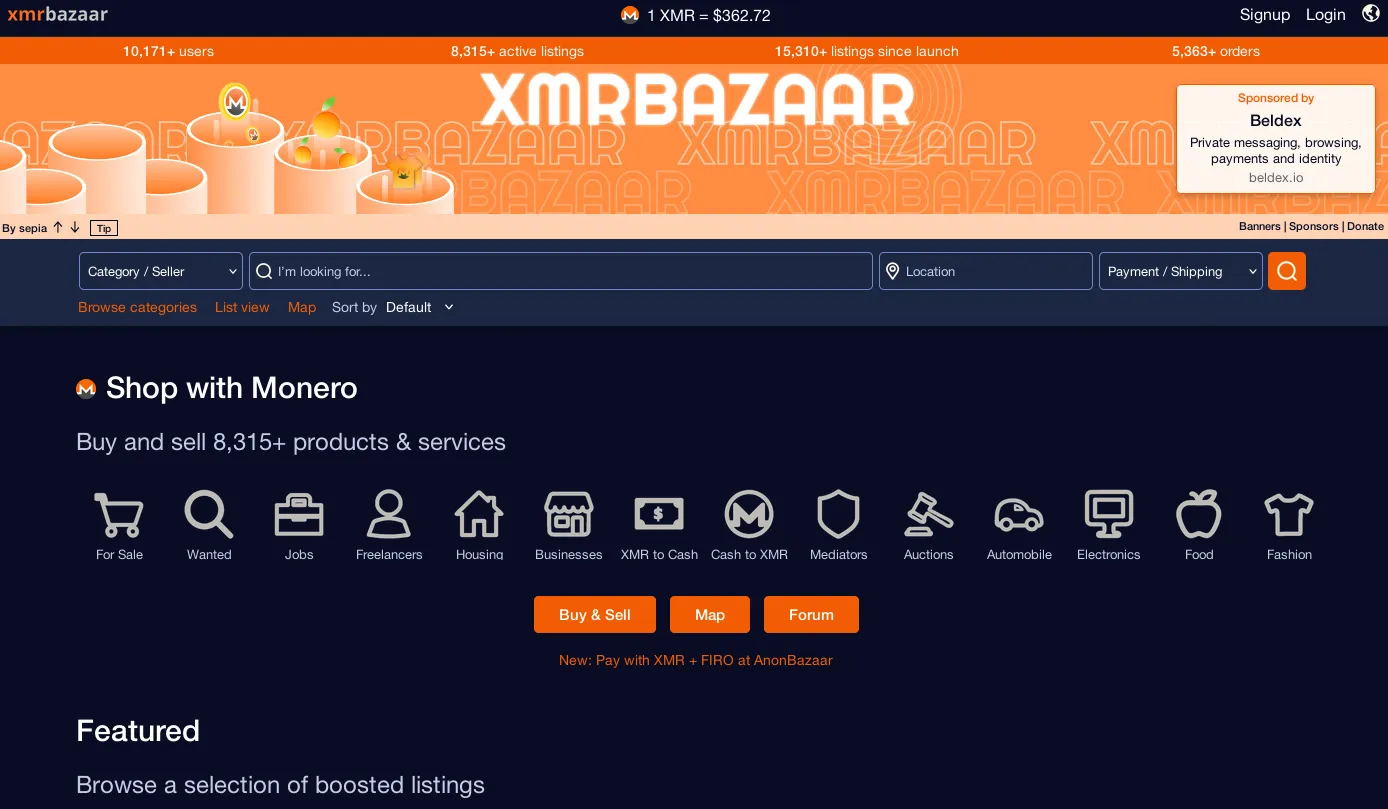
On XmrBazaar, you buy and sell (legal) goods and services directly between users. Think of it like Craigslist or eBay, but using Monero as the sole currency. It's simple: register, post something people are likely to buy (it could be video games, guitars, t-shirts, or simply an offer of euros in exchange for Monero), and with that, you can not only participate in the monero economy but also earn your first XMR.
You can also get XMR from non-custodial atomic-swap tools such as EigenWallet and BasicSwap, or from a Haveno peer-to-peer network such as RetoSwap. Haveno is the protocol. RetoSwap is one network that uses it, not a second product.
These are not custodial exchanges, and they are not risk-free. Trades fail, clients have bugs, and a counterparty can cheat or exploit the software. Check the project's current status before you send a large amount. Do not describe them as safe just because they are non-custodial.
Other privacy-friendly exchange options are listed at KYCnot.me.
Monero for Shops
Monero is especially convenient for merchants. Payments go straight from the customer to the merchant's wallet, without banks, payment processors, chargebacks, frozen merchant accounts, or withdrawal approvals. Fees are low, payments are global, and merchants can accept XMR using a regular wallet, a QR code, or a payment request.
Unlike transparent cryptocurrencies, Monero also protects commercial privacy: competitors, customers, and blockchain analytics companies cannot easily see the merchant's revenue, supplier payments, wallet balances, or customer activity.
Monero is also convenient for developers. The wallet and the node are separate components: The wallet stores keys and tracks payments, while the node only provides access to the blockchain. A store does not need a full node on day one. A full node is a few hundred gigabytes and growing. A pruned node still validates and uses much less. A store can start on a remote onion node and move to its own node later.
If a server only needs to notice incoming deposits, use a view-only wallet. It can generate receive addresses and see incoming payments. It cannot spend. It also cannot show a true balance once anything has been spent, because change looks like a new incoming output. A correct balance needs key images imported from the spend-key wallet. A hacked view-only server cannot withdraw the merchant's XMR. It can still read every incoming payment and amount. Keep the spend key offline, on another machine or in a hardware wallet.
Conclusion: Monero is the clearest digital cash project
Monero is more than a technical project. It is also a political and philosophical position. Without financial privacy, people can be monitored, profiled, censored, excluded, or punished. Transparent finance gives power to whoever controls the surveillance layer.
That does not mean privacy eliminates accountability. It means financial privacy should be the norm, not a reason for suspicion. Cash already works this way in the physical world. Monero attempts to provide it online.